
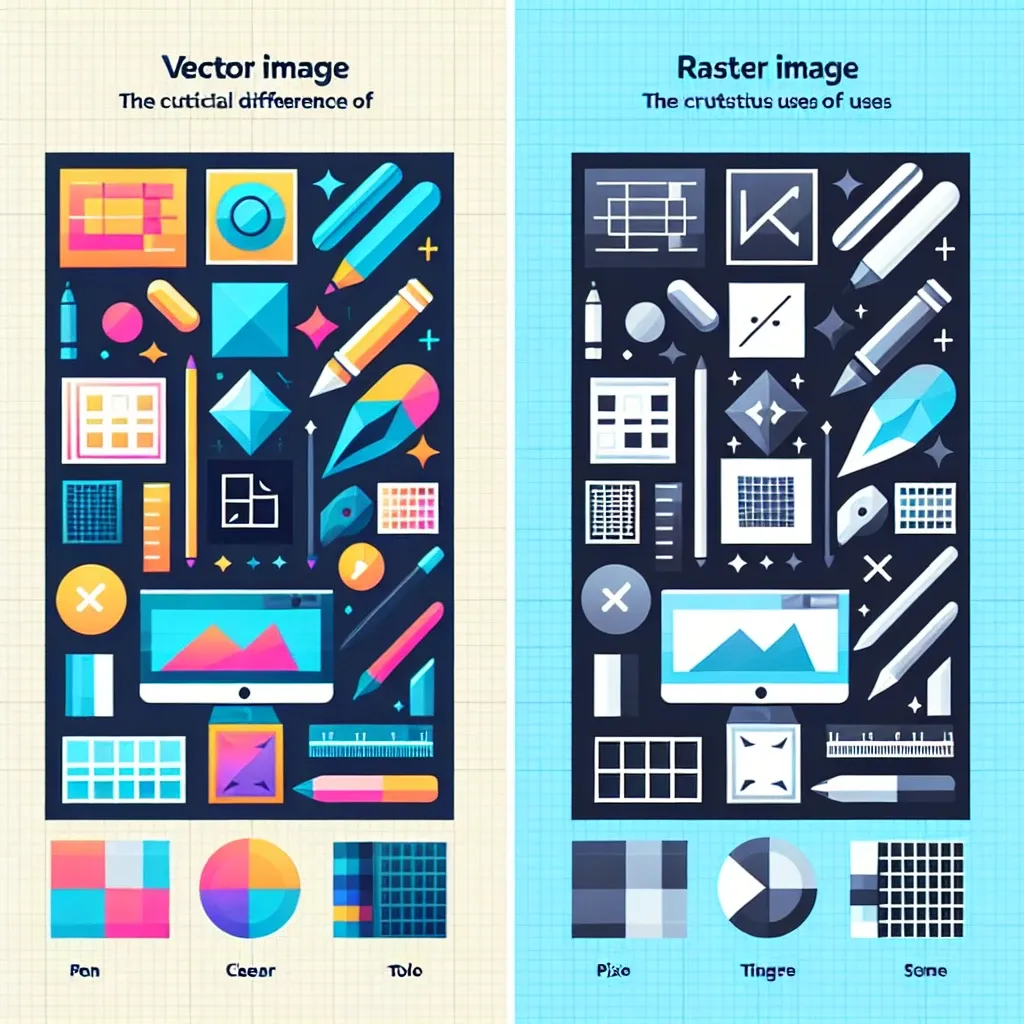
Raster vs Vector: Choosing the Right Format for Your Designs
When working with digital graphics, selecting the right image format is crucial for achieving the best results in your design projects.
1. What Are Raster and Vector Images?
Raster Images: Comprised of individual pixels, raster images are resolution-dependent and can lose quality when scaled up.
Vector Images: Created using mathematical equations and geometric shapes, vector graphics are resolution-independent and infinitely scalable.
2. Key Differences Between Raster and Vector Graphics
| Aspect | Raster Graphics | Vector Graphics |
|---|---|---|
| Composition | Pixels | Mathematical paths |
| Scalability | Loses quality when resized | Infinitely scalable |
| Resolution | Fixed resolution | Resolution-independent |
3. Advantages and Disadvantages of Raster and Vector Images
- Raster: Rich detail, but large file sizes and loss of quality when scaled.
- Vector: Infinitely scalable, but not ideal for complex imagery.
4. Common Use Cases for Raster and Vector Images
- Raster: Photography, web images, social media.
- Vector: Logos, branding, scalable graphics.
5. File Formats for Raster and Vector Graphics
| Type | Common Formats | Best Use Case |
|---|---|---|
| Raster | JPEG, PNG, GIF | Photos, web content |
| Vector | SVG, AI, EPS | Logos, icons |
6. Choosing the Right Format for Your Design Needs
Consider scalability, quality, and intended use when selecting between raster and vector formats.
7. Conclusion
Understanding the strengths of each format will help you create high-quality visuals for web, print, and branding needs.



Leave a Reply